"Let's Start a Band" editor Hugo Lindgren talks learning new skills as adults, music as community participation vs. pristine entertainment, and the importance—or unimportance—of art.
Our head-of-command here at bandNada, Jon F. Daily, isn’t one to send his staffers non-bandNada content (he loyally wears his brand on his sleeve and even his van license plate). But one fateful day a few months ago, he sent a New York Times Op Ed to our staff text thread.
The article was entitled, “Start a Band, Even If You’re Terrible.” “This is literally screaming about the bandNada ethos,” he told us.
So I read it. And he’s right.
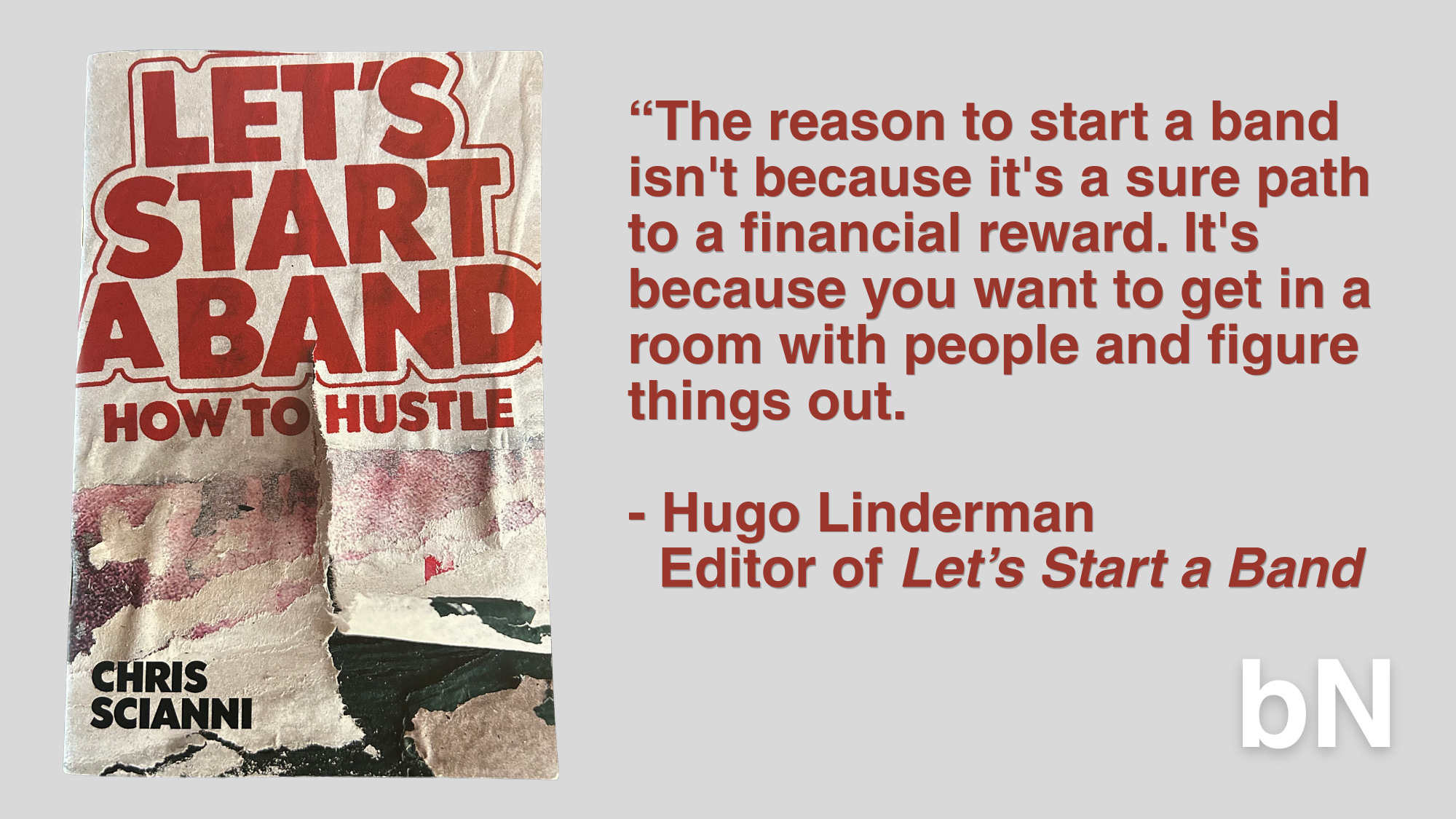
The article documents one man’s decision—Article author and professional editor Hugo Lindgren—to start a band again in his 50s, after not playing for several years. The idea came after helping his high school bandmate Chris Scianni put out a zine about his time in the music industry, entitled Let’s Start a Band. The zine celebrates musical creativity, and promotes just doing the damn thing, even if you’ve never touched an instrument or sang a note before.
A huge component of this is that music is for everyone, regardless of age, band experience, or even “talent.”
"Make it up as you go along. If nobody else wants to sing, you sing. Be a zealot about keeping your instrument in tune but nothing else. Force yourself to write one new song a week, no matter how dreadful the first ones come out."
While talking about May (now June’s) editorial, I got the idea to interview Hugo about his re-entry into musicianship. I wanted to get his story, because it’s always encouraging to see someone take that step.
Thankfully, Hugo and I were able to meet up on Zoom to chat about learning new things as adults, music as community participation vs. pristine entertainment, and the importance—or unimportance—of art.
In your NYT article, you mentioned that you grew up playing in bands but moved away from it as you got older, while Chris, your high school friend, really went for it.
Hugo: When I was in high school and college, I played in some bands, but was never as good as I wanted to be. I really enjoyed songwriting, but I had a bit of an inferiority complex as a player.
As I got older, I realized that almost everybody starts out… well, everybody starts out! Every band is terrible when they start. When U2 was starting out, they started writing songs only because they couldn't play other people's songs. That's a feeling that I identified with. If a band as great as they are starts there too, it shows that everybody's terrible in the beginning.
As I’ve grown a bit older, I’ve realized that adults forget it's okay to be bad at something they haven't done before.
Hugo: Self-consciousness really gets in the way of learning things. But then you see kids get up on stage and play terribly, and they're totally fine! [Laughs] They don't get intimidated by the idea that there might be people who are better than they are.
I often compare learning new skills to the first time I tried contact lenses. I was 12 years old, and sat there for 45 minutes trying to put them in my eyes. The guy from the [optical center] was like, “maybe this isn't for you.” But I was like, “no, it has to be for me!” And wallah, I made it work.
Hugo: That’s exactly right. The first time you do it, you feel like such an idiot. It’s terrible that that guy said, “this isn't for you.” I mean, how many times has he seen someone struggle to do that? It's okay to be a slow learner. Realize that things take time. Everyone talks about putting in their reps—It's become a boring catchphrase, but it really is true in music. To get good, you have to first be comfortable with not being as good as you wish you were.
As far as instruments go, what do you play?
Hugo: I play guitar. Recently I’ve been trying to play bass. I'm pretty terrible. [Laughs] The thing that I like about playing rhythm guitar is that you can improvise with the rhythm. But you don't want a bass player who's improvising a lot. I'm in my 50s learning to be disciplined as a bass player and it feels like a total mind fuck. [Laughs]
That’s awesome—playing and learning music for the sake of the craft. I see that mentality trickle down to a lot of smaller performance spaces, and it’s very powerful for community building. People make music for themselves, play it to other people, and then join the audience to see what the next act has created. That’s a community aspect I have only found in music, personally.
Hugo: Yeah. There's a great essay by Henrik Karlsson who write a Substack called Escaping Flatland. He starts with the question, “Why are there so many Swedish bands?” Sweden's a pretty small country, and yet it produces so many well-known bands and producers. The essay talks about what it means to build a scene, a community of shared passion and purpose. Karlsson talks about the way that people unblock each other and help expand their artistic ambitions, creating an environment in which the goal is to impress each other, not the outside world. The thing that drives it isn't a huge pot of gold, it’s togetherness.
Sometimes that can feel hard to find in New York, where everything feels like a ladder climb.
Hugo: And yet they do happen in New York. There are little pockets of it everywhere, but you can't really access it until you show up and commit to being part of it. It's not like you're going to walk into a room very often and hear the best band you ever heard. But if you’re open minded, finding those little pockets of people doing interesting stuff is an experience that's the exact opposite of climbing a ladder.
I had a friend outside of NYC recently tell me how much he loves his job, even though they don’t pay him as much as he’d like. He said he had great benefits, coworkers, and he liked the work, and he hopes he can work there forever. I don’t think I’ve ever heard that here, because it’s not solely about getting ahead. Your piece reminded me that there are moments of that here, where people are invested in the experience, not the competition.
Hugo: The way we think in New York is that we're going to see greatness. You want to go to a Broadway show, the opera, or the Philharmonic. I grew up with parents who did a lot of “high culture” things, and I found it excruciating. [Laughs] Sometimes I'll end up at the symphony, and be reminded of being ten years old and wanting to get out of there with every, every fiber of my being. [Laughs]
I used to be choosy about what bands I go to see. I guess I still am, in terms of going to a big show or whatever. But I try to say “yes” to any type of live music. I went to a show recently, and one opening band played a harp and sang, and one played xylophone. It’s music I would never listen to at home, but I loved that they were putting themselves out there in a small room. It wasn’t empty or anything, but to be a solo harpist, you're not being carried forward by the excitement of other people. You have to want to do it.
Something we were talking about in a bandNada meeting recently was the state of society as it relates to art. Someone asked, if our society is sick, does that mean our art is sick, too?
Hugo: It's hard to say. What does it mean that society is sick? A lot of terrible things are happening in the country, but the vast majority of interactions with your fellow citizens are good, you know? People are open to each other. For how expensive and difficult certain things are, the reason to live here is the access to people and the range of experiences, interests, skills, and whatever else. Obviously, people get angry about things that are happening in the country, but for the most part, they don't take it out on each other. So when people get together in music scenes, art scenes, literary scenes, food scenes, or anything else, I don’t think it carries over.
Maybe this is a big question, but do you think that art in general is important for society to connect with? Or is it more that what’s good for an individual is simply good for them?
Hugo: Both, I think. There are some people who want to do things they may never share—that don't have any social dimension, but are super meaningful to them. I'm definitely more of an extrovert—I want to do things that other people are aware of. So I don't do secret art projects or anything, but I love that people do.
Did you see that thing at the Museum of the City of New York? This truck driver—I think he lives upstate—built a model of New York City out of cardboard and other materials, hundreds of thousands of little buildings and stuff. He never really thought about showing it to anyone, but his daughter posted a video on TikTok about him and now it’s installed at the Museum. It was almost accidental that anyone else heard about it, but it's really amazing, and he only made it because he loved doing it.
That's a good example of someone doing something for themselves, but does the fact that it’s novel to do something artistic purely for the love of it mean we’ve devalued art in society? New York City values and prioritizes art like nowhere else, but I feel that there’s also so much wealth here that if it's not making dollars, it's not making sense.
Hugo: “Should it be this or that way?” I don't think of it in those terms. We're all drawn to big, popular things. But I went to see MJ Lenderman and Waxahatchee at The Beacon Theater recently, and it was so modest. They set the stage up with all these lamps and played sitting down. The Beacon is a big theater, and this felt like being in someone's living room. It bridged the divide you're talking about, where there's the big “successful” stuff that everybody wants to see, and the things that maybe don’t have many fans or aren’t making any money. It felt like they were bringing those two worlds together. I saw Geese around the end of last year, and that was different. I really like that too, but this felt more like you were a part of it. There was space for the audience in it. It wasn't just like, “wow, check out these people on a pedestal and how amazing they are!” There's a place for that, too—It's exciting when you're part of a big crowd, and people are screaming and losing their minds. But the Lenderman/Waxahatchee thing was just amazing.
Let’s get into the zine. You were originally approached by Chris to write about his experience in music, right?
Hugo: He got in touch because he wanted to write something about his three decades in the music world. I’m an editor. I work with a lot of writers on books or magazine articles. So we had lunch to chat about it. I have twin daughters who play music, and I’ve been encouraging them to play in bands. So I was like, “What if we worked on a zine about how to start bands and used your experience to direct them?” We thought of Chris as a character, the protagonist, because I didn’t spend 30 years playing gigs and feuding with my singer. [Laughs]
We soon realized that we wanted the audience for the zine to be as broad as possible, not young people or old people, but everybody, because there’s nobody who can't start a band! But there are things you’ve got to get past if you haven't done it before. Anything you're feeling or have reservations about—other people have felt those too and have worked through them. Those feelings of inadequacy, or whatever, everyone deals with that.
The first big problem we address in the zine is about finding a singer. Immediately, people are like, “oh, I can't sing.” Even people who turn out to be Aretha Franklin-like singers—It's almost like a default reaction. Our central advice is you should be the singer.
I think that self consciousness exists with singers because the voice is the most vulnerable instrument.
Hugo: We also tell some stories in the zine. One of them is to definitely don’t be afraid to be in bands with “freaks.” Maybe you’re the freak. [Laughs] A band is not meant to be five socially conforming people. People with not-easy personality traits or whatever, they can really make for an exciting band. That’s sort of the point, too. Talk to people you might not otherwise talk to. Embrace social awkwardness. I read band biographies and memoirs, and in pretty much every case, there’s a complicated social situation that is the key to a band becoming great.
I’ve read quite a few of those in the past years. It seems that I’m at the age where my favorite bands from high school are all ready to write books.
Hugo: People have different levels of truth telling in those things, but they tend to be very candid about when they started. Our zine isn’t so much about what happens when you're mega successful. The reason to start a band isn't because it's a sure path to a financial reward. It's because you want to get in a room with people and figure things out. The goal is making something. The music is essential, but the making something can be going out and putting on shows. It can be recordings that you're proud of, t-shirts, and all those other fun things that you do when you get momentum going. The music is essential, but the inspiration for it is human connectivity and finding a shared purpose.
How did you design the zine?
Hugo: We used Mixbook. We made all kinds of mistakes along the way, but we thought of making the zine as like being in a band, and forged ahead. I managed to get this really amazing designer to do the cover, and he was just such a mensch about doing it! Like being in a band, you depend on the help of other people.
We're going to do a new version of it because—it wasn't X-rated in any way, but it had few reference to drugs and sex or whatever that felt a little inappropriate for younger readers and not really necessary anyway. We want to engage a younger audience, and some of those things created a bit of a barrier.
Less accessible.
Hugo: Exactly. There's plenty to talk about without getting into that stuff. Chris has an eight year old kid who's a drummer. He did a version of “Iron Man” that blew the house down! We want parents of eight year olds to feel like they could show the zine to their kid. If we tell a story about Chris giving a huge bag of weed to the booker at a club in Manhattan that he'd been dying to get into, it's a great story, but it doesn't really need to be in there.
Lastly, did you or Chris grow up with zine culture at all?
Hugo: We both did, but it was more important to me. I grew up on the Upper East Side, and there used to be a zine store here in the East Village called See Hear. I would look forward to going there for weeks, buy a big stack of zines, and read them cover-to-cover. [Zine culture] waxed and waned over the years, but I guess it's kinda coming back.
We just published 100 of the first zine. We were just going to do one event, and we weren't really planning on selling them. But they all disappeared! I literally have two copies left. The zine is like a token of being part of a club! Having the zine means you’re officially part of our little scene.
You can sign up for the Let’s Start a Band Mailing List here and get ready for that second edition.
Side note, Hugo wrote some really great pieces documenting The Wrens, who I know many of you are fans of. You can find links to those here.
